The recent UN Security Council resolution renewing the mandate of MINURSO has exposed deep fractures among the Council’s permanent members. Russia, which abstained from the vote on the US-drafted text, strongly criticized both its content and the way it was negotiated. In a firm and politically charged statement, Russia’s ambassador revealed that the diplomatic battle over Western Sahara is far from settled — and that the Sahrawi people’s right to self-determination remains under threat.
🟥 “An unbalanced text” used to push a national agenda
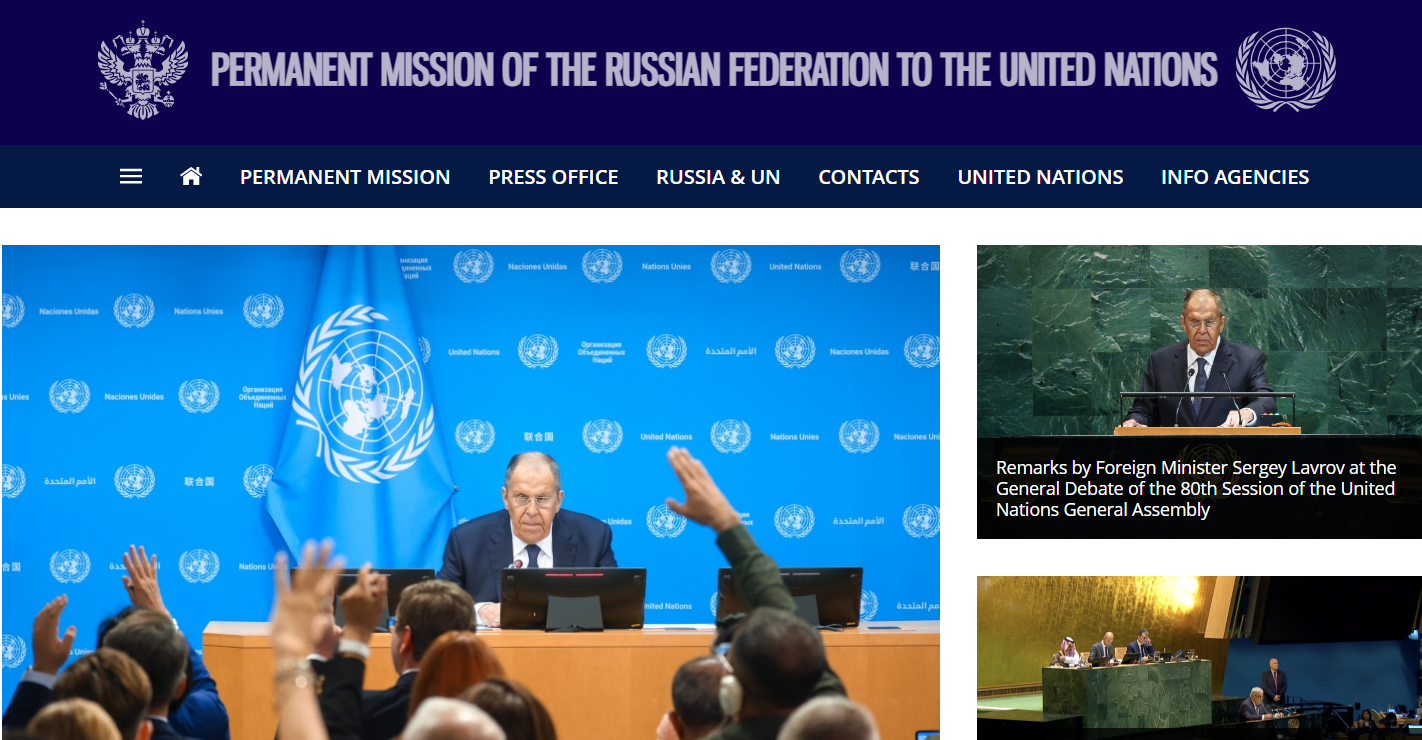
In his explanation of vote, Russian Ambassador Vassily Nebenzia denounced the partiality of the US-sponsored draft:
“We could not support such an unbalanced text. We were also surprised by the approach taken by the penholders, who decided to use the Security Council to advance their national agenda.”
Russia accuses the United States of bypassing regular diplomatic channels at the UN by avoiding detailed discussions with all Council members — a breach of the consensus-based working method expected in sensitive decolonization files like Western Sahara.
🟦 The “Group of Friends of Western Sahara” under fire
Nebenzia also took aim at the so-called Group of Friends of Western Sahara — traditionally the core space where the first drafts of resolutions were negotiated:
“We do not take the ‘Group of Friends of Western Sahara’ into account: given the revised national positions of our partners, the group has become a platform for ‘collective monologue’.”
This critique makes clear that, as several member states shift toward Morocco’s autonomy “solution,” what was once presented as a diplomatic coordination mechanism is now perceived as a closed space serving one-sided agendas.
⚠️ Russia warns: this resolution could reignite the conflict
Russia ultimately chose to abstain rather than block the resolution outright — but not without issuing a stark warning:
“We hope that this reckless and unilateral approach from our American colleagues will not reignite a conflict that has been simmering for decades.”
This is more than a procedural objection: it’s a geopolitical signal that any attempt to erase the right to self-determination in Western Sahara could have military repercussions. Since November 2020, the ceasefire has already broken down and large sections of the territory are again under open conflict between the Sahrawi Army (SPLA/EPLS) and Moroccan forces.
🗳️ No solution can exclude the right to self-determination
Despite its abstention, Russia made clear that the legal framework of decolonization is not negotiable:
“We trust that the Secretary-General’s Personal Envoy will strive for a mutually acceptable solution that allows the people of Western Sahara to freely exercise their inalienable right to self-determination. There can be no alternative to this scenario.”
With this statement, Moscow draws a red line against the idea — pushed by the United States and France — that the Moroccan autonomy plan could replace the internationally recognized right of the Sahrawi people to decide their own future.
🔍 Geopolitical analysis: what the Russian position reveals
(with Carlos Ruiz Miguel)
Russia’s explanation of vote contains two key revelations highlighted by Spanish international law professor Carlos Ruiz Miguel (@DesdelAtlantico), a long-time observer of the Western Sahara conflict.
🟥 1. Russia was ready to veto the resolution
“Rusia ha revelado que de no suprimirse la referencia al plan marroquí como ‘única solución’, habría vetado la resolución.”
(Russia has revealed that if the reference to the Moroccan plan as the ‘only solution’ had not been removed, it would have vetoed the resolution.)
This means the original US draft openly violated the legal framework of UN decolonization — by attempting to impose the Moroccan autonomy proposal in place of the UN-mandated referendum on self-determination.
🟥 2. Russia warns the resolution may worsen the conflict
“Rusia advierte que esta resolución no solo no resuelve el conflicto sino que puede agravarlo.”
(Russia warns that this resolution not only fails to solve the conflict but may worsen it.)
As Ruiz Miguel points out, this warning is not rhetorical: Russia is Algeria’s main arms supplier, and Algeria is the key military and diplomatic backer of the Frente Polisario. If the political process is derailed in favor of unilateralism, escalation on the ground is a real possibility.
🧭 Conclusion: between law and geopolitical pressure
Russia’s intervention confirms that, despite growing diplomatic pressure from the United States, France, and their allies, international law remains a major obstacle to Morocco’s annexation of Western Sahara. It also exposes widening cracks within the UN Security Council regarding the handling of the conflict.
In a context of resumed armed struggle and increased militarization of the territory, ignoring the Sahrawi people’s right to self-determination — upheld by the UN Charter — cannot lead to peace. It can only feed instability and prolong a conflict that has already lasted more than 50 years.