Since October 31, 2025, the conflict in Western Sahara has entered a critical phase. That is the analysis offered by Christopher Ross, former UN Personal Envoy, in an article that highlights what many of us have long been denouncing: the UN’s gradual drift toward legitimizing Morocco’s autonomy plan represents the most negative aspect of the latest resolution — a serious setback for the principle of self-determination.
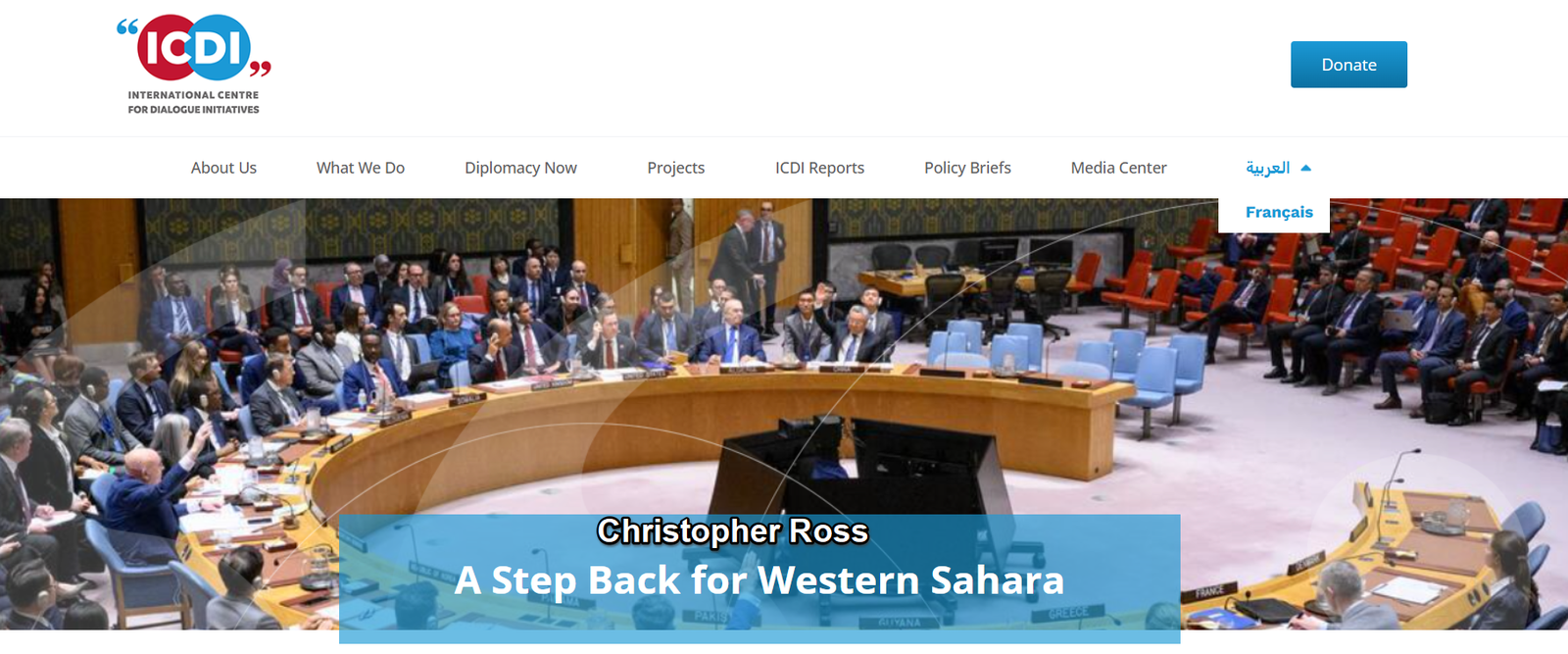
Below we present a commented reading of his text, published by the International Centre for Democratic Initiatives (ICDI) under the title “A Step Back for Western Sahara”, written by Christopher Ross, former Personal Envoy of the UN Secretary-General for Western Sahara (published November 7, 2025).
A Step Backward
Christopher Ross builds his argument on a strong premise: the UN Security Council resolution adopted on October 31, 2025, far from being a step forward, represents “a step backward” in the search for a just solution to the Western Sahara conflict.
“The resolution that the United Nations Security Council adopted on October 31 on the 50-year-old Western Sahara conflict is a step backward despite the claims of its supporters.”
For more than a decade, every resolution had reaffirmed the same principle: support for “a just, lasting, and mutually acceptable political solution, which will provide for the self-determination of the people of Western Sahara.”
“For more than a decade, the text of each resolution has reaffirmed the need for a ‘just, lasting, and mutually acceptable political solution, which will provide for the self-determination of the people of Western Sahara.’”
This time, however, the resolution (drafted under U.S. “pen-holding”) explicitly inserts new language suggesting that the autonomy plan presented by Morocco in 2007 — under Moroccan sovereignty — could constitute “the most feasible basis” for a settlement.
“But this time the resolution (under US pen-holding) inserts, for the first time in explicit terms, language proposing that the autonomy plan submitted by Morocco in 2007 — under Moroccan sovereignty — could constitute ‘the most feasible’ basis for a settlement.”
Although the final text softened the wording (“a feasible basis” instead of “the most feasible”), Ross warns that this shift is not trivial: it elevates the Moroccan proposal to a privileged position while relegating self-determination — still a binding legal obligation of the UN toward non-self-governing territories — to the background.
A Political Drift Led by Washington
According to Ross, this change results from a deliberate choice by the United States, continuing the controversial “recognition” of Moroccan sovereignty declared by Donald Trump in December 2020. In this context, MINURSO gradually loses its original purpose, since the referendum — the mission’s founding mandate — has been emptied of meaning.
On the Ground: Unilateral Changes and Diplomatic Silence
Ross observes that Morocco is not merely maintaining its occupation; it is consolidating its de facto control through settlement, resource exploitation, and large-scale infrastructure — all enabled by international complacency.
“That matters because Morocco continues to transform the situation on the ground: settlement of Moroccan citizens in the territory, exploitation of natural resources, strengthening of administrative structures — all while showing little appetite for negotiating an outcome that recognises the self-determination of the Sahrawis.”
“Without meaningful pressure from Algeria, the Polisario Front and its backers among the Sahrawi people have little incentive to accept the autonomy proposal as it stands today.”
At this stage, the author adopts a cautious middle ground: while denouncing the Security Council’s drift, he calls for mobilizing new generations of Sahrawis, Moroccans, and Algerians to “build bridges” — an idea that might be seen as implicitly normalizing the current stalemate.
“First, activists and thought-leaders must engage the younger generations of Sahrawis, Moroccans and Algerians in building bridges towards mutual understanding and respect …”
A Relevant but Insufficient Conclusion
Ross concludes by warning of the growing risk of escalation if regional tensions between Morocco and Algeria continue to worsen:
“In sum, both the Western Sahara conflict and the poor relations between Morocco and Algeria require active management to prevent tensions from escalating into serious threats to regional peace and stability.”
On this point, our reading agrees with his: no peace will ever be possible without the full recognition of the Sahrawi people’s right to self-determination, nor without dismantling the political and economic mechanisms sustaining the Moroccan occupation.
Editorial Conclusion
The reading of this article shows that even moderate voices linked to the UN process acknowledge the setback represented by Security Council Resolution 2797. This change is not merely technical — it is strategic. It legitimizes the Moroccan occupation and turns the principle of self-determination into empty rhetoric.
Faced with this, it is more urgent than ever to reopen the debate on the legality of the Saharan question, to reaffirm the role of the Frente Polisario as the legitimate representative recognized by the United Nations, and to expose the diplomatic complicity and economic exploitation that sustain the occupation.
PLATFORM “DO NOT FORGET WESTERN SAHARA”